


Home › What is matcha?
The matcha guide · 13 chapters
What is matcha? The complete guide to matcha tea
Matcha tea is a Japanese green tea made of whole leaves ground into a fine powder. You drink the leaf itself.
The tea plants are shaded before harvest and the leaves are traditionally stone-ground. You whisk matcha into water instead of steeping it.
★★★★★ 4.5/5 · 262 shop reviews
By the Matcha Matcha team · updated in November 2026
The key figures in this guide are sourced at the bottom of the page.

The essentials in 30 seconds
Six things to remember, then four numbers. The detail and the sources follow, chapter by chapter.
A powder of whole green tea leaves
You whisk it into water and drink all of it.
Grown in Japan, notably in Kagoshima
And in four other main regions, covered in chapter 3.
Shaded for 20 to 30 days before harvest
Then steamed, dried and stone-ground.
1 g per cup, one bamboo spoon
A 50 g pouch makes 50 cups.
Water at 70 to 75 °C, 20 seconds of whisking
Above 80 °C, the bitterness comes out.
Naturally contains caffeine
About 19 to 44 mg of caffeine per 1 g.
20 to 30 days
of shading before picking
1 g
of powder per cup of 70 to 100 ml
70 to 75 °C
the right water temperature
50 cups
in a 50 g pouch
Our Organic Ceremonial Matcha: grown in Kagoshima, certified organic, 50 cups per pouch.
Chapter 1 · Definition
What is matcha?
Matcha is a Japanese green tea ground into a very fine powder. You whisk it into hot water and drink all of it.
The name says it: in Japanese, 抹茶 (matcha) means "ground tea". It comes from the same plant as every other tea, the tea plant (Camellia sinensis). Three things set it apart: how it grows, how it is processed and how you drink it.
Twenty to thirty days before harvest, the tea plants are covered so that they grow in the shade. The leaf then produces more chlorophyll, which gives it its bright green, and keeps more L-theanine, the amino acid that makes matcha taste round. The young leaves are picked, steamed and dried flat, then the stems and veins are removed. This leaf is called tencha. Ground in a stone mill, it becomes matcha.
Above all, you don't steep it. You whisk 1 g of powder into a little hot water and drink everything: the whole leaf ends up in the cup, suspended in the water. That changes the taste, the texture and what a cup contains.
Matcha vs green tea: what really changes
An ordinary green tea such as sencha grows in full sun, is rolled into needles and steeps for a few minutes. Then you throw the leaves away, so you only drink what the water has drawn out. With matcha, nothing is left in the teapot. The table compares matcha green tea with the other Japanese green teas you are most likely to come across.
| Tea | Shading | Leaf form | Preparation | What you drink | Colour and taste |
|---|---|---|---|---|---|
| Matcha | 20 to 30 days | Tencha ground into powder | Whisked for 20 s in water at 70-75 °C | The whole leaf | Bright green; smooth, vegetal, umami |
| Gyokuro | About 3 weeks | Rolled needles | Steeped at 50-60 °C | The infusion | Light green; very umami |
| Sencha | None, full sun | Rolled needles | Steeped for 1 to 2 min at 70-80 °C | The infusion | Yellow-green; fresh, slightly bitter |
| Hojicha | None | Roasted leaves and stems | Steeped at 90-95 °C | The infusion | Brown; toasted, woody |
| Green tea in teabags | Usually none | Broken leaf pieces | Steeped for 2 to 3 min | The infusion | Varies with quality |
Swipe the table to see all the columns.
Temperatures and times: common guidelines from Japanese producers, to adjust to the tea.
Japanese matcha or matcha from elsewhere: what the pouch tells you
"Matcha" is not a protected name: the word means a ground green tea, not an origin. Matcha is also made in China, Korea and Vietnam, and some powders are ground in Japan from leaves grown elsewhere. So look on the pouch for the country and region where the leaves grew, and not only for the place of grinding or a flag. A precise origin ("Kagoshima, Japan") is worth more than a vague "Japanese tea".
Matcha from other origins is not bad as such: it tastes different, often more vegetal, and the price is different too. What matters is that the label says so clearly. We cover the other things to check in our guide on how to choose the best matcha powder.
Chapter 2 · How it is made
How is matcha made?
In six steps: the tea plants are shaded, the young leaves are picked, steamed and dried, the stems are sorted out, and the leaf is ground in a stone mill.
Each step leaves its mark in the cup. Shading gives the colour and the smoothness. Picking decides how tender the leaf is. Steaming fixes the green, sorting removes what would taste bitter, and the mill decides how fine the powder is. A matcha that skips a step is easy to recognise: the colour is duller, the powder grainier and the taste drier.
-

Shading
20 to 30 days
The tea plants are covered with cloths or a straw structure. With much less light, the leaf makes more chlorophyll and keeps its L-theanine.
In the cup: A greener colour, a smoother and rounder taste.
-

Picking
Late April to May
The young spring shoots are picked. Grades made for drinking on their own usually come from this first harvest, the ichibancha.
In the cup: A tender leaf, less bitterness.
-

Steaming
A few seconds
The leaves are steamed the same day. Oxidation stops and the green is fixed: this is what makes a tea a green tea.
In the cup: A bright green that does not turn brown.
-

Drying
A few hours
The leaves dry flat. They are not rolled like sencha leaves. They become brittle and break into flakes.
In the cup: A leaf that is easy to grind finely.
-

Sorting, tencha
After drying
The stems and veins are removed. Only the flesh of the leaf is left: tencha, the raw material of matcha.
In the cup: Less bitterness, a finer texture.
-

Stone mill
Very slow
The tencha passes between two granite millstones that turn slowly, so the powder does not heat up. A stone mill works slowly, and the powder comes out very fine.
In the cup: A very fine powder, a dense foam.


Sources: Kochman et al., Molecules, 2021; Wikipedia, "Matcha", production section.
This also explains the price of a good matcha. A shaded plot gives fewer leaves, picking young shoots takes time, and a stone mill works slowly. Very cheap powders often come from a fast grinder and later leaves. They have their place in baking, less so in a cup you drink on its own.
Matcha words
Twelve Japanese words keep coming up on pouches and in recipes. Here they are, one sentence each.
Tencha 碾茶
The leaf once it has been shaded, steamed, dried flat and stripped of its stems. This is what gets ground.
Tana, kabuse
The two ways of shading: tana covers the tea plants from a distance, kabuse lays a cloth directly on the plants.
Ichibancha 一番茶
The first harvest of the year, in spring. Later harvests are more mature and stronger.
Cultivar
A selected variety of tea plant: Yabukita, Saemidori, Okumidori and others. Each has its own taste and colour.
Ishiusu 石臼
The stone mill, often made of granite, that turns tencha into powder.
Chasen 茶筅
The bamboo whisk that makes the foam in about twenty seconds.
Chashaku 茶杓
The bamboo spoon used for measuring: one spoon for one cup.
Chawan 茶碗
The traditional tea bowl of the ceremony, wide enough for the whisk to move.
Usucha 薄茶
"Thin" tea: little powder, plenty of water, a fine foam. The everyday one.
Koicha 濃茶
"Thick" tea: a lot of powder, little water, a texture like cream. Kept for the finest powders.
Umami 旨味
The round, almost broth-like taste that L-theanine gives. It is what makes matcha smooth.
Furui 篩
The sieve that breaks up lumps before you pour the water.
Chapter 3 · History and origin
Where does matcha come from? History and origin
Powdered tea began in China, but it became the matcha we drink today in Japan, from 1191 onwards.
Under the Song dynasty, the Chinese already ground their tea leaves and whisked the powder. The Japanese monk Eisai brought this method back in 1191. Tea first took hold in Zen monasteries, then at court. In the 16th century, growing in the shade gave matcha its green colour and its smoothness, and Sen no Rikyū turned its preparation into an art: the tea ceremony, or chanoyu.
-
10th to 13th century
The whisked tea of the Song
In China, under the Song dynasty, people grind the leaves and whisk the powder in a bowl. The method later disappears in China.
-
1191
Eisai returns
The monk Eisai brings tea seeds back from China, along with the way of preparing tea as a whisked powder.
-
14th century
Kyoto prefecture
The tea gardens around Kyoto become the reference for the court and the temples. Tea is drunk in Zen monasteries.
-
16th century
Shade and Sen no Rikyū
Growers cover the tea plants before harvest. The tea master Sen no Rikyū sets the spirit of the ceremony: harmony, respect, purity and tranquillity.
-
20th century
Kagoshima takes its place
The south of Japan becomes a major tea region. Today Kagoshima is one of the country's two leading tea-producing prefectures.
-
Today
From the ceremony to the latte
Matcha is drunk all over the world: with water, as a latte, iced or in baking.
Sources: Wikipedia, "Matcha" and "Japanese tea ceremony". Kagoshima's rank: Japanese Ministry of Agriculture (MAFF), 2024 statistics.
Usucha and koicha: the two ways of drinking it
The ceremony has two preparations. Usucha, "thin" tea, is foamy and is the one people drink every day. Koicha, "thick" tea, is kneaded more than whisked and is kept for the finest powders. Our everyday dose, 1 g for 70 to 100 ml, is a light usucha: easier to like when you are starting out. To learn more about the movements and the meaning of each object, read our article on the Japanese tea ceremony.

| Preparation | Powder | Water | Texture | When |
|---|---|---|---|---|
| Usucha | About 1.75 g | About 75 ml | Foamy, light | Ceremony, everyday |
| Koicha | About 3.75 g | About 40 ml | Thick, no foam | Ceremony, very fine powders |
| Our cup | 1 g | 70 to 100 ml at 70-75 °C | Fine foam | Every day |
Usucha and koicha doses: Wikipedia, "Matcha", consulted on 25/10/2026.
Chapter 3 · The regions
Kagoshima, Kyoto, Nishio, Shizuoka, Yame: the matcha regions
Japanese matcha comes mainly from five regions, from southern Kyushu to the foot of Mount Fuji. Each gives it its own character.
Climate, soil and the date spring arrives change how fast the leaf grows, how smooth it is and how it smells. In Kagoshima, the early spring and the volcanic soils give a smooth, round matcha: it is the one we chose. Pick a region to find it on the map and in the table.
Kagoshima Prefecture, southern Kyushu
Kagoshima
A mild, humid climate, volcanic soils and one of the earliest springs in Japan. Its matchas are often smooth and round. This is where our matcha comes from.
Fukuoka Prefecture, northern Kyushu
Yame
Misty hills, also known for gyokuro. Rich matchas with a marked umami.
Kyoto Prefecture
Kyoto
The historic home of the tea ceremony, with cool, misty valleys. Fine matchas with a marked umami.
Aichi Prefecture
Nishio
A major tencha region, on the Yahagi plain. A lot of matcha for cooking and drinks, and some fine grades too.
Shizuoka Prefecture
Shizuoka
A very large green tea region at the foot of Mount Fuji, best known for sencha. Its matchas are more vegetal and fresh.
| Region | Prefecture | Climate | Spring harvest | Taste style (tendency) |
|---|---|---|---|---|
| Kagoshima | Kagoshima, southern Kyushu | Mild, humid, volcanic soils | One of the earliest in Japan | Smooth, round, no bitterness |
| Yame | Fukuoka, northern Kyushu | Misty hills | Late April | Rich, marked umami |
| Kyoto | Kyoto | Cool valleys, river mists | Early May | Fine, umami; the historic home |
| Nishio | Aichi | Fertile Yahagi plain | May | Balanced; a lot of matcha for cooking and drinks |
| Shizuoka | Shizuoka, at the foot of Mount Fuji | Temperate, sunny | Late April to May | Vegetal, fresh; a region best known for sencha |
Swipe the table to see all the columns.
These are general tendencies, not a rule: the same garden gives very different matchas depending on the cultivar and the season.
For the detail of each region, its cultivars and its landscapes, read our guide to the matcha regions.

Why we chose Kagoshima
"I wanted a matcha that anyone could like from the first cup, with water or as a latte. The one from Kagoshima is the smoothest we have tasted, and it takes a minute to prepare. This is the Japanese matcha we sell, to you and to the cafés that serve it."
Alex, founder of Matcha Matcha
Our matcha at a glance
Taste
Smooth, vegetal, no bitterness
Origin
Kagoshima, southern Kyushu, Japan
Harvest
First harvest
Growing
Yabukita cultivar, shaded for about 21 days for a smoother taste
Grinding
Stone-ground, for a fine foam
Organic
Certified organic
Ingredient
Only one: pure matcha
Lab tests
Tested by an accredited laboratory, lab report sent on request
Storage
24 months unopened; once opened, we recommend finishing it within 30 to 45 days
Size
50 g, which makes 50 cups
Chapter 4 · The grades
Ceremonial, premium, culinary: the matcha grades
These words are not official standards. Each brand uses them in its own way, but they point to three uses.
What separates the grades is the age of the leaf, the season of the harvest and the care taken in grinding. The younger the leaf and the slower the mill, the smoother, greener and more expensive the matcha. Ceremonial grade means powders made for drinking on their own, with water. Premium grade, sometimes called "everyday", is mostly used for lattes and iced drinks. Culinary grade is meant for baking: its stronger taste holds up against sugar, butter and the heat of the oven. More detail in the matcha grades explained.
Nothing stops you cooking with a ceremonial grade, but the other way round gives a bitter cup. It is the most common beginner's mistake: buying a cheap "culinary" matcha, drinking it with water and deciding that matcha is bitter.
| Criterion | Ceremonial | Premium | Culinary |
|---|---|---|---|
| Leaves | Young shoots, usually from the first harvest | First or second harvest | Later harvests, more mature leaves |
| Colour | Bright, vivid green | Clear green | Duller green, sometimes yellowish |
| Taste on its own | Smooth, umami, no bitterness | Vegetal, slight bitterness | Strong, bitter |
| Use | With water, and as a latte | Lattes, iced drinks | Baking, cooking |
| Grinding | Stone mill, slow | Stone mill or grinder | Often a fast grinder |
Swipe the table to see all the columns.

Our choice
One pouch, for water and for lattes
Our Organic Ceremonial Matcha is smooth enough to drink on its own and has enough taste for a latte. You don't have to choose between three powders. You only change the way you drink it.
Chapter 5 · The taste
What does matcha taste like?
A good matcha tastes vegetal and fresh, with umami, a roundness close to broth, and a slightly sweet finish.
The first impression is of cut grass or young spinach. Then comes umami, the roundness that L-theanine gives, stronger in well-shaded matchas. The finish is smooth and long. Texture matters as much as taste: a well-whisked matcha is velvety, with a fine foam that softens the first sip.
At 70-75 °C and 1 g per cup, a ceremonial grade matcha stays smooth, even for people who don't like green tea. Compare the profiles below: the gauges show a tendency for each grade, not a measurement.
Taste profile by grade
-
Douceurtrès marqué
-
Umamitrès marqué
-
Amertumetrès faible
-
Végétalmoyen
-
Finesse de la moussetrès marqué
Where does the bitterness come from?
Bitterness is not the normal taste of matcha. It almost always comes from one of these five mistakes, from the most common to the rarest.
-
Water that is too hot
Above 80 °C, the bitterness comes out. Stay between 70 and 75 °C.
-
Too much powder
1 g is enough for 70 to 100 ml. Only double it for a latte.
-
A culinary grade drunk on its own
It is made for baking: with water, it is strong and bitter.
-
An oxidised powder
Left open for a long time, or kept in light or heat, it turns yellow and loses its taste.
-
Not whisked enough
Lumps are left and make some sips harsh. Sift, then whisk for 20 seconds in a W shape.
A taste of seaweed or fish: is that normal?
A marine note, of seaweed or broth, is normal: it is umami, stronger in heavily shaded matchas and in some cultivars. It softens at 1 g and with a little more water. A smell of hay, dust or old cardboard is another matter, and so is a powder that is turning yellow. They point to an oxidised matcha: it has lost its freshness and is best kept for baking.
For us, the best matcha
Taste the difference
-
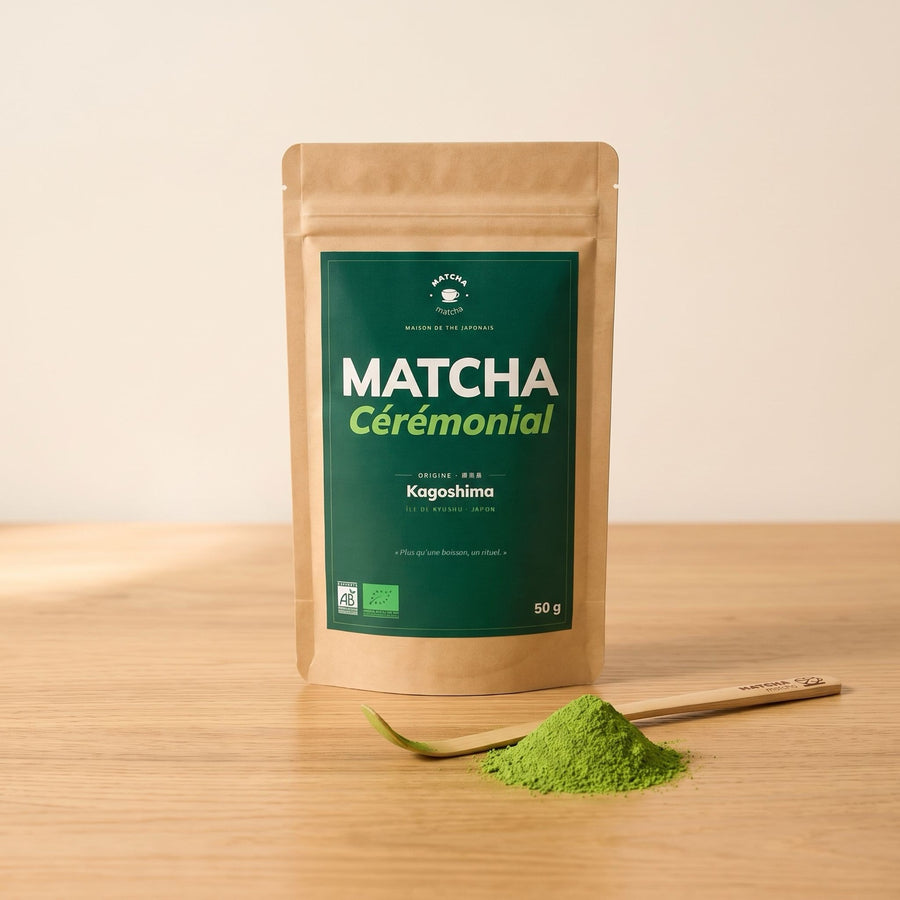 OrganicKagoshima, Japan
Organic Ceremonial Matcha
Smooth from the first sip, even if you don't like green tea. With water or as a latte, it is ready in a minute.
29,90 € · about €0.60 a cup
-
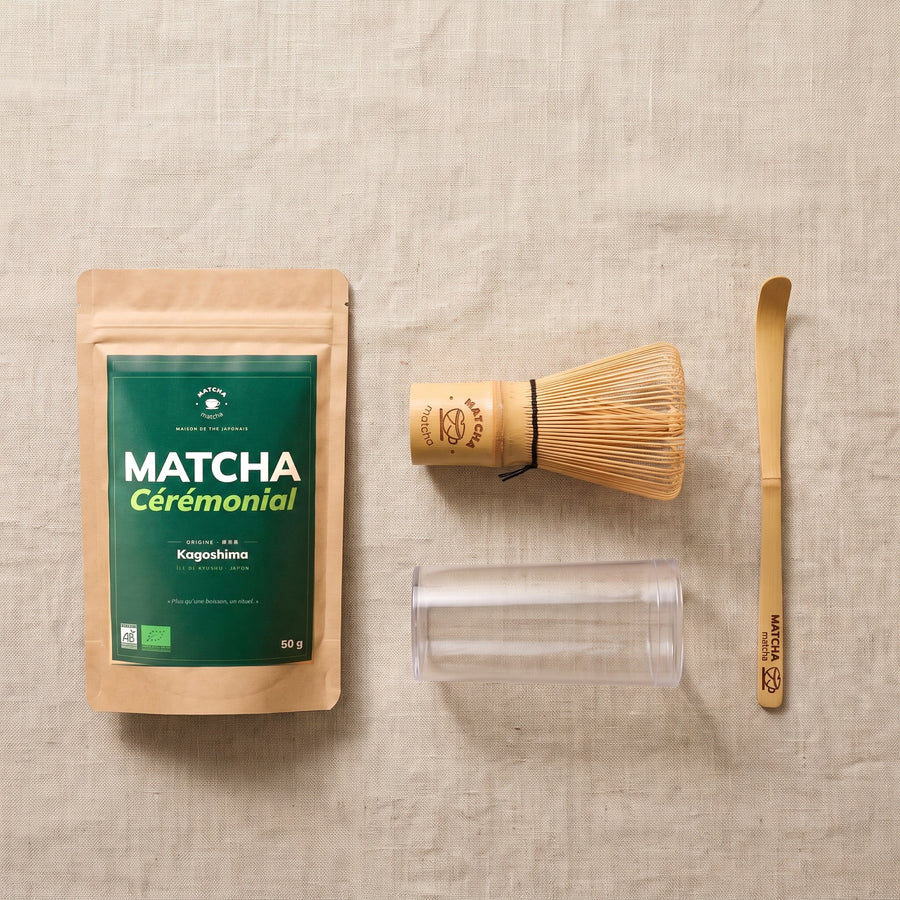 Getting started
Matcha Kit
Everything for your first cup: the matcha, the bamboo matcha whisk (chasen) and the spoon.
44,90 € · 9% cheaper than buying the three separately
4.5/5 · 262 shop reviews · Delivered in 3 to 4 days, no customs fees
Chapter 6 · Preparation
How do you drink matcha tea? Four steps
For one cup: 1 g of matcha, 70 to 100 ml of water at 70 to 75 °C, and 20 seconds of whisking in a W shape. Every step in detail: how to make matcha.
It takes one minute and two tools: a bamboo spoon to measure and a bamboo matcha whisk (chasen) to make the foam. The recipe does not change from one day to the next. Only the amount of water varies, depending on how strong you like your matcha.
-

Measure 1 g
One full bamboo spoon. Sift the powder into the cup: that is the secret of a cup with no lumps.
-

Pour water at 70-75 °C
70 to 100 ml. Without a thermometer, mix two thirds boiling water with one third cold water.
-

Whisk for 20 seconds
In a W shape, fast, from the wrist, without scraping the bottom. A fine, dense foam should cover the surface.
-

Drink straight away
The powder settles if you wait. If it does, a quick whisk is enough.


The 20-second timer
Start it with your first stroke of the whisk.
Matcha tools
Three things are enough: the powder, water at the right temperature and a cup. The rest makes the job simpler and the foam finer. A wide cup works well.
| Level | Item | What it is for | If you don't have one |
|---|---|---|---|
| Essential | Matcha | 1 g per cup | No substitute |
| Essential | Water at 70-75 °C | Keeps it smooth | Two thirds boiling water, one third cold water |
| Essential | A cup | 70 to 100 ml, wide enough to whisk in | A large mug |
| Useful | Bamboo matcha whisk (chasen) | A fine foam in 20 seconds | Shaker, electric milk frother |
| Useful | Bamboo spoon (chashaku) | Measures 1 g in one go | Scales accurate to the gram |
| Useful | Small sieve | Breaks up lumps | A tea strainer |
| Traditional | Bowl (chawan), whisk holder | The gesture of the ceremony, the shape of the whisk | Optional |
Swipe the table to see all the columns.
To start with nothing missing, the Matcha Kit brings together the powder, the whisk and the spoon.
And without a whisk?
It works, and the result is a little less fine. With a small shaker that closes tightly: 1 g of matcha, a little cold water, 15 seconds of shaking, then hot water in the cup. Never shake hot water in it: it can spurt out when you open it. With an electric milk frother: 15 seconds in the cup. A jam jar will do as a shaker. The foam will be coarser and a few lumps may be left. Sifting the powder first helps a lot.
To get started
A fine foam in 20 seconds
Everything for your first cup in a single parcel. Not sure? Compare our matcha sets.
-
Getting started
Matcha Kit
The matcha, the bamboo matcha whisk (chasen) and the measuring spoon, together.
44,90 € · 9% cheaper than buying the three separately
Chapter 7 · In the kitchen
Matcha in the kitchen: latte, iced, baking
You can drink the same powder on its own, add milk to it or use it to flavour desserts. A latte takes 2 g, which is 2 bamboo spoons.
The matcha latte is the gentlest way in: 2 g whisked into 30 ml of water at 70 °C, then 150 ml of hot or cold milk. All the steps and variations are in how to make a matcha latte. In summer, you pour the same base over ice: that is iced matcha. In baking, sift the powder with the flour or the sugar to avoid lumps, and choose gentle oven temperatures: above 180 °C, the green darkens. To go further, here is how to cook with matcha, from cakes to savoury dishes.


Chapter 8 · In the cup
What a cup of matcha contains
A cup of matcha contains caffeine and L-theanine, both naturally present in the tea leaf.
Because you drink the whole leaf, the cup also holds what the leaf contains: chlorophyll, which gives the colour, and catechins, polyphenols specific to tea. We drink matcha first of all for its taste. If the subject interests you, we have put together what is known about the benefits of matcha, and what is not known, with the studies to back it up.
What the studies say
The tea leaf contains catechins, including EGCG, polyphenols that have been studied a great deal (Kochman et al., 2021). This research is about green tea in general, not about one product in particular.
How much caffeine is in a cup?
About 19 to 44 mg for a 1 g cup, depending on the matcha. That is usually less than an espresso or a filter coffee. A matcha latte made with 2 g contains about twice as much. Theine and caffeine are the same molecule. In tea, it comes with L-theanine, an amino acid found in the leaf. For the detail, read our article on caffeine, theine and L-theanine.
| Drink | Caffeine | Dose | Source |
|---|---|---|---|
| Cup of matcha | About 19 to 44 mg | 1 g in 70 to 100 ml | Kochman et al., 2021 |
| Matcha latte | About 38 to 89 mg | 2 g | Same study, dose doubled |
| Espresso | About 80 mg | 60 ml | EFSA |
| Filter coffee | About 90 mg | 200 ml | EFSA |
| Black tea | About 50 mg | 220 ml | EFSA |
| Adult guideline | Up to 400 mg | Per day | EFSA, 2015 |
Swipe the table to see all the columns.
These figures are average values published for matcha.
My caffeine for the day
Add what you drink on a normal day.
Votre journée
99 à 124 mg
de caféine environ
EFSA guideline for a healthy adult: up to 400 mg a day, 200 mg during pregnancy. An indicative calculation based on the values in the table, not medical advice.
Chapter 8 · Day to day
When should you drink matcha?
Ideally in the morning or early afternoon, because it naturally contains caffeine. Many people drink it at breakfast, or on a break instead of a second coffee. With or without a meal is a matter of taste. In the evening, if you are sensitive to caffeine or sleep badly, choose a drink that has none.
Can you drink it every day?
Yes, you can drink it every day, like tea or coffee, as long as you count its caffeine along with your other drinks. EFSA considers that up to 400 mg of caffeine a day raises no safety concerns for a healthy adult. See our guidelines for drinking matcha every day.
Pregnancy and caffeine sensitivity: the precautions
During pregnancy, EFSA's guideline is 200 mg of caffeine a day at most, all drinks included. Pregnant or breastfeeding women, children, and people who are sensitive to caffeine or on medication should ask their doctor. Read next: matcha and pregnancy, and the side effects of matcha.
How many calories are in a cup?
Per 100 ml of matcha made with 3 g in 200 ml of water: 29 kJ, or 7 kcal, according to the technical data sheet of our Organic Ceremonial Matcha. In a latte, most of the calories come from the milk and any added sugar. More detail, lattes included: matcha calories.
Matcha and aluminium: what you need to know
The tea plant naturally takes up aluminium from the acidic soils it grows in. All teas contain it, and so does matcha, since you drink the whole leaf. There is no European maximum level for aluminium in food. Anses, the French food safety agency, sets a reference value that covers everything you eat in a day, over the long term. So drink matcha in moderation, as you would any drink.
Our matcha is tested by an accredited laboratory, and the lab report is sent on request. To find out more: aluminium in matcha.
Chapter 9 · Choosing
How can you tell a good matcha?
By its bright green colour, a precise origin, organic certification, a clear date, a very fine powder and a fair price per gram.
You can check these six criteria before you even open the pouch, or in the first few seconds. In the cup, at 70-75 °C and 1 g, a good matcha is smooth and vegetal, with no bitterness.
Bright green
Neither yellow nor khaki. The colour tells you how fresh it is and how well it was shaded.
A precise origin
The country and region where the leaves grew, not just "Japan".
Certified organic
The organic label and the EU organic logo printed on the pouch.
A clear date
A best-before date printed on the pouch.
A very fine powder
Soft as talc between your fingers, with no grains.
A price per gram
Compare per gram and per cup, not per pouch.
The colour chart: what the colour tells you
Colour is the first clue, in daylight. It doesn't tell you everything, but a yellow or khaki matcha will never be smooth.
Bright green
Young, well shaded, fresh.
Clear green
A good everyday matcha.
Dark green
More mature leaves, a stronger taste.
Yellow-green
Late harvest or oxidised powder.
Khaki, brown
Old or badly stored.
Shades are indicative.
To read a pouch line by line, see how to choose the best matcha powder.
Why choose organic matcha?
With matcha, you don't throw the leaves away: you drink them. That is why many matcha drinkers choose organic. Certification guarantees that the tea is grown under the European organic regulation (EU 2018/848), without synthetic pesticides, and checked every year by a certification body.
It says nothing about taste or freshness: the other criteria cover that. Our matcha is certified organic and tested by an accredited laboratory; the lab report is sent on request. More detail on the Our quality approach page.
Compare per gram, then per cup
A 30 g pouch at €25 looks cheaper than a 50 g pouch at €30. It is the other way round: €0.83 per gram against €0.60. Always compare per gram, then per 1 g cup. At 1 g per cup, our Organic Ceremonial Matcha works out at about €0.60 a cup, so you can buy organic matcha from Japan for the price of a coffee. For reference, the average of four premium organic matchas sold in France is €1.08 per gram (prices checked on 06/11/2026).
A very low price often points to a culinary grade, a late harvest or a vague origin. A very high price isn't always justified either: you may be paying for a brand or for packaging. The best guide is still the whole picture: colour, origin, organic, freshness and price per cup.
Compare another matcha, per cup
Enter the price and weight of a pouch you know.
Prix du sachet
Poids du sachet
Cet autre matcha
0,83 €
la tasse de 1 g
Notre Matcha Cérémonie Bio
0,60 €
la tasse de 1 g
Chapter 10 · Storage
How should you store matcha?
Tightly closed, somewhere cool, away from light and moisture. Once it is open, we recommend finishing it within 30 to 45 days.
Matcha is a delicate powder: air, light, heat and moisture make it lose its colour and aroma. Unopened, ours keeps for 24 months, up to the date printed on the pouch. Once it is open, treat it like a fresh product. If your kitchen is warm, keep it in the fridge in its tightly closed pouch, and let it come back to room temperature before you open it, so that condensation does not make it damp. After the date, it loses its colour, aroma and smoothness: keep it for baking.
Closed
Press out the air and close the zip after each cup.
Somewhere cool
Away from the oven and the kettle.
Away from light
In its opaque pouch or a closed container.
Quickly once opened
We recommend finishing it within 30 to 45 days of opening.
How long does a pouch last?
A 50 g pouch makes 50 cups: one a day for more than a month. You can also drink it as a latte, at 2 g per cup, and then it goes faster.
Chapter 11 · Comparisons
Matcha vs coffee, matcha vs mate: the comparisons
Matcha usually has less caffeine than coffee and a vegetal taste instead of a roasted one, and it takes a minute to prepare.
Coffee gives you more caffeine in one go, with a roasted bitterness. Mate, a South American plant, steeps for a long time in a gourd and is shared. Ube, a purple yam from the Philippines, is not a tea at all: people compare it with matcha for its colour and its lattes. Many people keep their morning coffee and switch to matcha in the afternoon. For the purple one, see ube vs matcha.
| Criterion | Matcha (1 g) | Coffee (espresso) | Mate | Ube |
|---|---|---|---|---|
| Plant | Tea plant, Camellia sinensis | Coffee plant | Yerba mate, Ilex paraguariensis | Purple yam, Dioscorea alata |
| Usual origin | Japan | Tropical regions | Argentina, Brazil, Paraguay | Philippines |
| Caffeine | About 19 to 44 mg | About 80 mg | Varies with preparation | None |
| Preparation | Whisked for 20 s in water at 70-75 °C | Machine or filter | Steeped in a gourd, drunk through a filter straw | As a powder or purée, in lattes or desserts |
| Taste | Vegetal, smooth, umami | Roasted, bitter | Herbal, woody, bitter | Sweet, vanilla-like |
| Colour | Bright green | Brown | Yellow-green | Purple |
Swipe the table to see all the columns.
Chapter 12 · Questions
Your questions about matcha tea
The ten questions we are asked most often, and that people type into Google most. Each answer can be read on its own.
What is matcha tea?
Matcha is a Japanese green tea ground into a very fine powder. The tea plants are shaded for a few weeks before harvest, then the leaves are steamed, dried and ground in a stone mill. You whisk the powder into hot water, so you drink the whole leaf instead of steeping it.
What is the difference between green tea and matcha?
Both come from the same tea plant. Ordinary green tea is steeped, then the leaves are thrown away. Matcha is made from shaded, ground leaves that you whisk and drink whole. That is why it has a more intense taste, a bright green colour and a slightly foamy texture.
How much matcha per cup?
1 g, which is one bamboo spoon, in 70 to 100 ml of water at 70 to 75 °C, whisked for 20 seconds. So a 50 g pouch makes 50 cups. For a matcha latte, double the dose: 2 g, which is two bamboo spoons, in 30 ml of water and 150 ml of milk.
Is it good to drink matcha every day?
Yes, you can drink it every day, like tea or coffee. A cup naturally contains caffeine, so count it along with your other drinks. EFSA considers that up to 400 mg of caffeine a day raises no safety concerns for a healthy adult. During pregnancy, ask your doctor for advice.
Should you drink matcha in the morning or the evening?
Ideally in the morning or early afternoon, because matcha naturally contains caffeine. If you are sensitive to it or sleep badly, avoid it late in the day. In the evening, choose a caffeine-free drink. A 1 g cup contains less caffeine than a 2 g latte.
What are the contraindications of matcha?
Matcha contains caffeine. Depending on the dose and the time of day, it can disturb sleep, and in sensitive people it can make the heart beat faster. Tea can also reduce the absorption of iron taken at the same meal, and green tea can interact with some medicines. If you are pregnant or on medication, or if it is for a child, talk to your doctor. During pregnancy, EFSA's guideline is 200 mg of caffeine a day at most, all drinks included.
Why is matcha so expensive?
It takes more work than green tea: shading the tea plants, picking the young leaves, sorting out the stems and veins, then grinding in a stone mill that turns slowly. But a cup only needs 1 g of powder, so ours works out at about €0.60 a cup.
How do you drink matcha tea?
From a cup, just after whisking it. Put 1 g of powder in 70 to 100 ml of water at 70 to 75 °C, then whisk for 20 seconds in a W shape. The powder stays suspended in the water: you drink the whole leaf. You can also have it as a latte, with 2 g, or over ice.
What are the benefits of matcha tea?
People drink it first of all for its taste. A cup contains caffeine and L-theanine, both naturally present in the tea leaf, as well as catechins, polyphenols that have been studied a great deal. This research is about green tea in general. More detail in our article on the benefits of matcha.
Can you drink matcha cold?
Yes. First whisk 1 g of matcha in a little water at 70-75 °C, or shake it with cold water in a shaker, then top up with cold water or milk and add ice. In cold water alone, the powder mixes less well: a shaker or a milk frother helps a lot.
A member of our team replies within 24 hours.
Ready for your first cup?
-
OrganicKagoshima, Japan
Organic Ceremonial Matcha
Smooth from the first sip, even if you don't like green tea.
29,90 € · about €0.60 a cup
-
Getting started
Matcha Kit
Everything for your first cup: the matcha, the bamboo matcha whisk (chasen) and the spoon.
44,90 € · 9% cheaper than buying the three separately
4.5/5 · 262 shop reviews · Delivered in 3 to 4 days, no customs fees
Chapter 13 · Sources
Sources
The figures in this guide come from these documents, consulted in October 2026.
- Price check of four premium organic matchas sold in France, 23/10/2026.
- Preparation guidelines from Japanese producers (temperatures and times in the table in chapter 1).
- EFSA, Scientific Opinion on the safety of caffeine, EFSA Journal 2015; 13(5): 4102. Guidelines of 400 mg a day for an adult and 200 mg during pregnancy. efsa.europa.eu
- EFSA, "Caffeine" page and 2015 opinion: about 80 mg for a 60 ml espresso, 90 mg for a 200 ml filter coffee, 50 mg for a 220 ml cup of black tea. efsa.europa.eu
- Koláčková T. et al., "Matcha Tea: Analysis of Nutritional Composition, Phenolics and Antioxidant Activity", Plant Foods for Human Nutrition, 2020; 75: 48-53. Composition of matcha, including caffeine. pubmed.ncbi.nlm.nih.gov
- Kochman J. et al., "Health Benefits and Chemical Composition of Matcha Green Tea: A Review", Molecules, 2021; 26(1): 85. Production, composition, and caffeine from 18.9 to 44.4 mg per gram of matcha depending on the sample. doi.org
- Regulation (EU) 2018/848 on organic production.
- Anses, opinion 2023-MPEX-0137, May 2025: oral toxicological reference value of 40 µg per kg of body weight per day. anses.fr
- Japanese Ministry of Agriculture (MAFF), tea production statistics by prefecture: in 2024, Kagoshima became Japan's leading tea-producing prefecture, ahead of Shizuoka; it is also first for tencha. maff.go.jp
- Wikipedia, "Matcha" and "Japanese tea ceremony": history, usucha and koicha doses.
- 2026 technical data sheet of the Organic Ceremonial Matcha: nutritional values, allergens, storage.


Professionals
Do you serve matcha?
Serve a smooth matcha that your customers like from the first cup. Organic Ceremonial Matcha in bulk from 1 kg, or under your own brand. Prices and documents are in our trade area, which is open only to cafés, restaurants and retailers.