


Best matcha powder: how to choose and where to buy matcha
You can find the best matcha powder at an online specialist, a tea house, an organic shop or a Japanese grocery, as long as the seller answers six questions before you pay: a bright green shown in a photo, the growing region in writing, organic certification, a single ingredient, the harvest stated, and a price per gram that suits how you will use it.
We sell our own ceremonial grade matcha. We put it through the same checklist further down the page, and you can check every answer.

By the Matcha Matcha team · updated 8 November 2026 · 10 min read

The checklist
- Bright green
- Region in writing
- Certified organic
- A single ingredient
- Harvest stated
- Price per gram
To do before you pay
How do you spot the best quality matcha? Put your pouch through the checklist
Take the pouch you have at home, or the one you are thinking of ordering. Answer from what is written: what you guess does not count. It takes one minute, and "not clear" is a real answer.
- 1
Is the green bright?
In a photo of the powder and of a prepared cup.
How to check
A clear, luminous green, neither yellow nor khaki. The colour tells you about the shading of the tea plants and how fresh the powder is, and nothing else. If the product page only shows the pouch, answer "not clear".
- 2
Is the growing region written down?
The country, then the region.
How to check
"Tea from Japan" with no region leaves the question open. For Japan, look for a name such as Kagoshima, Nishio, Yame or Shizuoka: each has its own style. A pouch that hints at Japan with a name or Japanese characters, but never says so in writing, should make you stop.
- 3
Is the matcha certified organic?
The word organic or the European logo, on the pouch or the product page.
How to check
The label tells you how the tea was grown and that a certifying body checked it. It says nothing about taste, and an organic pouch with no region and no harvest is still a vague pouch.
- 4
Is the ingredient list one word long?
Matcha, and nothing else.
How to check
With sugar, milk powder or a flavouring, what you are holding is a drink mix. That is a different product, and its price per gram cannot be compared with a pure powder.
- 5
Is the harvest stated?
First harvest, young spring leaves.
How to check
The harvest is what makes a matcha smooth. A seller who knows their powder knows which harvest it comes from, and says so.
- 6
Do the use and the price per gram match?
For drinking, for lattes or for cooking, and the price divided by the weight.
How to check
A cooking powder sold at the price of a drinking powder does not add up. Always work out the price per gram, the only figure that lets you compare two pouches: the calculator further down does the division.
Where to buy matcha
Which shop you buy from matters little. What matters is what you can read before you pay. Each kind of shop has its strengths, so start with what you want the matcha for.
Drinking it with water
You need a smooth powder from the first harvest. A specialist or a tea house can tell you where it comes from: ask them.
As a latte
A smooth powder is still nicer, even with milk. Look closely at the price per gram: at 2 g per latte, it counts double.
In baking
A culinary grade is enough and costs less. Just check that the ingredient list is one word long.
Tasting or getting advice
Go and see someone who can answer your questions, and ask to see the powder if you can.
Having it today
In a shop, read the label as you would a product page, and keep this page open on your phone.
Paying a fair price
Online, you can compare prices in two clicks. Work everything out per gram before you decide, with the calculator further down.
You need a smooth powder from the first harvest. A specialist or a tea house can tell you where it comes from: ask them.
Good fit
Online specialist
Ideal if
you want to read everything before you pay and compare prices.
Less suited if
you insist on seeing the powder first.
Check
The region, the harvest, the price per gram, the delivery time.
Good fit
Tea house, tea room
Ideal if
you are new to matcha and want advice, sometimes a tasting.
Less suited if
you mostly compare prices.
Check
The origin, the recommended use, the price per gram.
Good fit
Japanese grocery
Ideal if
you are looking for imported products.
Less suited if
the label is not translated.
Check
The translation of the label: origin, weight, use.
Good fit
Organic shop
Ideal if
organic comes first for you and you want matcha today.
Less suited if
the pouch does not say what it is meant for.
Check
The recommended use and the region. If you want to drink it with water, the pouch has to say so.
Good fit
Online marketplace
Ideal if
you already know which product you want.
Less suited if
this is your first purchase.
Check
Who is really selling, the origin, the exact weight.
Where to buy matcha in a shop?
You see the pouch, rarely the powder. Pick it up and go through the checklist in the aisle: it works standing up too. Look at the packaging, and ask for advice if someone is there to answer.
Where to buy matcha powder online?
You see nothing, so the product page has to tell you everything: a photo of the powder and of a prepared cup, the region, the weight, the price, the dispatch time. Ask the seller a question before you order, and you will soon see whether they know their powder. To see our selection, you can buy organic matcha from Japan in our shop.
Our matcha, put through the same checklist
We sell our own matcha, so we are not a neutral judge. Here are its answers, line by line. You can read all of them on the pouch and on its product page. It is up to you to decide whether it ticks your boxes.
1
Is the green bright?
Tea plants shaded before the harvest. The powder and a cup are shown in photos on the product page.
Yes
2
Is the growing region written down?
Grown in Kagoshima, in the south of Japan.
Yes
3
Is the matcha certified organic?
Certified organic.
Yes
4
Is the ingredient list one word long?
Matcha.
Yes
5
Is the harvest stated?
First harvest.
Yes
6
Do the use and the price per gram match?
Made for drinking, with water or in a latte, at €0.60 per gram.
Yes
Organic
Kagoshima, Japan
Organic Ceremonial Matcha
Smooth from the first sip, even if you don't like green tea.
★★★★★ 4.5/5 · 262 shop reviews
€29.9050 g · 50 cups · about €0.60 a cup
Delivered in 3 to 4 days, no customs fees
Its limit. We sell a matcha made for drinking. If you mainly want a powder for baking, a culinary matcha will cost you less.
What you can ask for. Ask any seller for their lab tests, or how they check their powder. A question about our matcha? A member of our team replies within 24 hours. For our matcha, you can request the lab report on our quality approach page.
How much does good matcha cost?
Compare per gram, then per cup. Pouches come in 20, 30, 40 or 50 g, and only the price per gram tells you which one really costs the most.
On 6 November 2026 we noted the retail price of four premium organic matchas sold in France: €1.08 per gram on average. Our 50 g pouch is €0.60 per gram. A cup takes 1 g, so that is about €0.60 a cup, and €1.20 of matcha for a latte.
The price only means something once the pouch has passed the checklist. A pouch that does not answer the six questions is not a bargain, even at a low price.
The pouch you are looking at
Price per gram. For your pouch: €0.83 for a 1 g cup, €1.67 for a 2 g latte.
50 gmake 50 cups at 1 g each
2 gfor a latte, twice the amount for a cup
30 to 45 daysto finish an opened pouch, closed tightly and kept away from light and heat
To go further

The guideWhat is matcha

PrepareHow to make matcha tea

TasteWhat does matcha taste like
Pitfalls to avoid when you buy matcha
What a label really tells you
Clear label
Organic matcha
Made-up example
- 1Grown in Japan, Shizuoka region
- 2Ingredient: matcha
- 3First harvest, to drink with water or in a latte
- 4Net weight: 30 g
Vague label
抹茶 Ceremonial grade
Made-up example
- 1The authentic taste of Japan
- 2Green tea powder, sugar, flavouring
- 3Packed in Europe
- 4Weight unreadable in the photo

From bright green to dull green: colour is the first thing to look at, and one photo of the powder is enough. A product page that shows none is hiding the main thing from you.
ceremonial
premium
culinary
Words that no rule defines
Two pouches with the same word on them can have nothing in common. Ours has "Ceremonial" in its name, which is exactly why we put it through the same checklist as the others.
Three signs that should make you stop
A powder with no origin. No country, no region, only a Japanese look.
A pouch that lets light through. Matcha does not like light, heat or air: its packaging has to protect it from all three.
A very low price with no explanation. On a pouch with no region and no harvest, it should make you wary. A very high price is no guarantee either.
What is the best matcha for each use?
There is no single best matcha: it all depends on what you do with it.

With water
With water, you taste the matcha on its own, and nothing covers up an average powder. You need a smooth grade from the first harvest: 1 g for 70 to 100 ml of water at 70 to 75 °C.

In a latte
Milk covers part of the taste, but a smooth powder is still nicer. Allow 2 g per latte, so double the amount when you do the sums.

In baking
A culinary grade has a stronger taste, holds up better in the oven and costs less. There is no point using a powder made for drinking.
| Type of product | Origin on the pouch | Best use | Colour |
|---|---|---|---|
| Matcha from Japan, named region, organic | Country and growing region | With water, in a latte | Bright green |
| "Japanese" matcha with no region | Country only | Varies, check it | Clear green to dull |
| Premium or everyday grade | Varies | Lattes, iced drinks | Clear green |
| Culinary grade | Often vague | Baking, cooking | Duller, sometimes yellowish |
| Matcha from other countries | Country stated | A different taste, a different price | Varies |
| Latte mix | Varies | Read the ingredient list | Not applicable |
Japan or another country?
Japan has a long tradition of shaded tea and fine milling. Other countries make matcha too, with a different taste and a different price. Nothing stops you choosing one, as long as the pouch says clearly where the powder comes from.
Organic or not?
All else being equal, organic is a criterion we keep, and we chose it for our own matcha. It is about how the tea is grown, and it is not enough on its own to make a good matcha.
Frequently asked questions
This guide is written and updated by the Matcha Matcha team, which sells its own matcha and names no brand other than its own. Our story
What is the best matcha in Europe?
The one that passes the checklist for your use. We do not publish a ranking of brands: we sell our own, so we would not be a neutral judge.
What is the best type of matcha?
For drinking with water or in a latte, a high grade matcha from Japan, first harvest, with a bright colour. For baking, a culinary grade does the job very well.
Can you buy matcha in a shop?
Yes, in a tea house, an organic shop or a Japanese grocery. Look at the origin, the weight and the ingredients, just as you would online.
Where can you find good quality matcha tea?
From a seller who states the region, the harvest and the price per gram, and who answers your questions, online or in a shop.
How do you spot a fake matcha?
Start with the ingredients: sugar, milk powder or a flavouring mean it is a drink mix. Then look for the growing region and a photo of the powder. A dull powder with no origin and a very low price should make you stop. If you are still unsure, ask: a serious seller answers.
How do you know a matcha really comes from Japan?
Look for "grown in Japan", followed by a region. "Packed in Japan" or "ground in Japan" describes one step, not the place where the tea grew. A Japanese name or Japanese characters prove nothing.
Which matcha should you buy to drink every day?
A smooth first-harvest powder, at a price per gram you can keep paying. One cup a day comes to 30 g a month, and an opened pouch keeps for 30 to 45 days. Before you make it a habit, read what the studies really say and the possible side effects.
What is the price of a good matcha?
Four premium organic matchas surveyed in France cost €1.08 per gram on average (prices noted on 6 November 2026). Our 50 g pouch is €0.60 per gram. Whatever the price, put the pouch through the checklist.
How do you buy a good matcha?
Look first at the growing region and the harvest, check there is only one ingredient, then compare the price per gram. If the product page does not answer, ask the seller before you pay.
You know what to look for. Now it is time to taste.
-
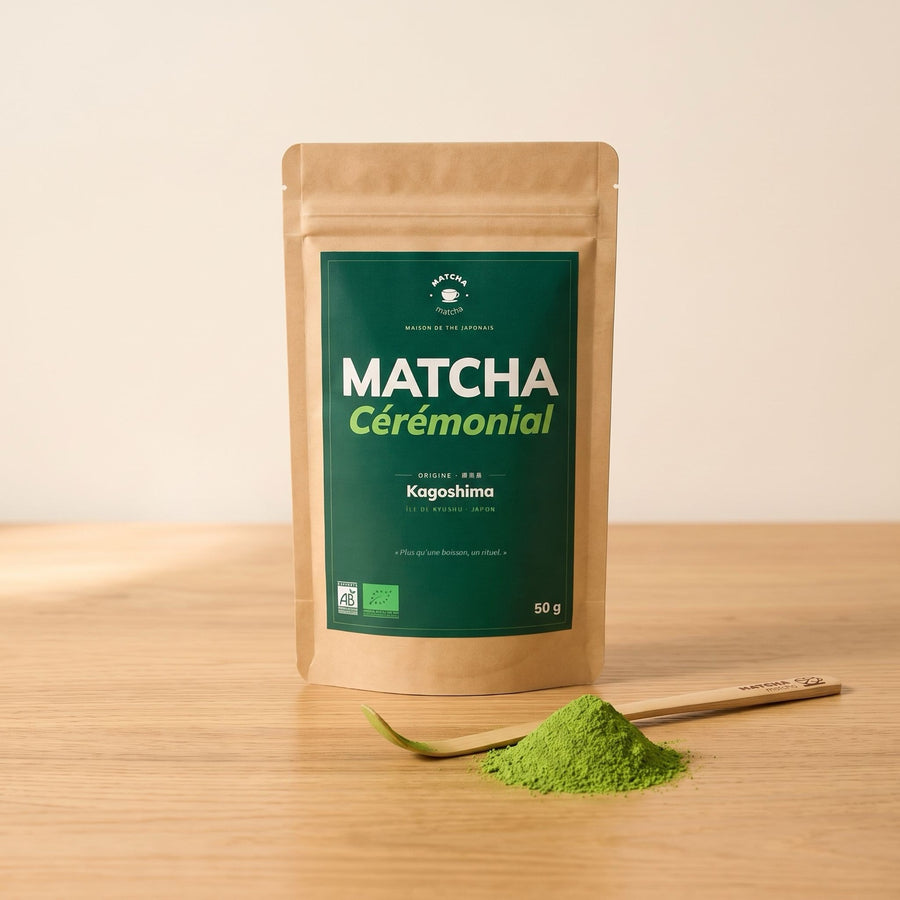 OrganicKagoshima, Japan
Organic Ceremonial Matcha
Smooth from the first sip, even if you don't like green tea.
29,90 € · about €0.60 a cup
-
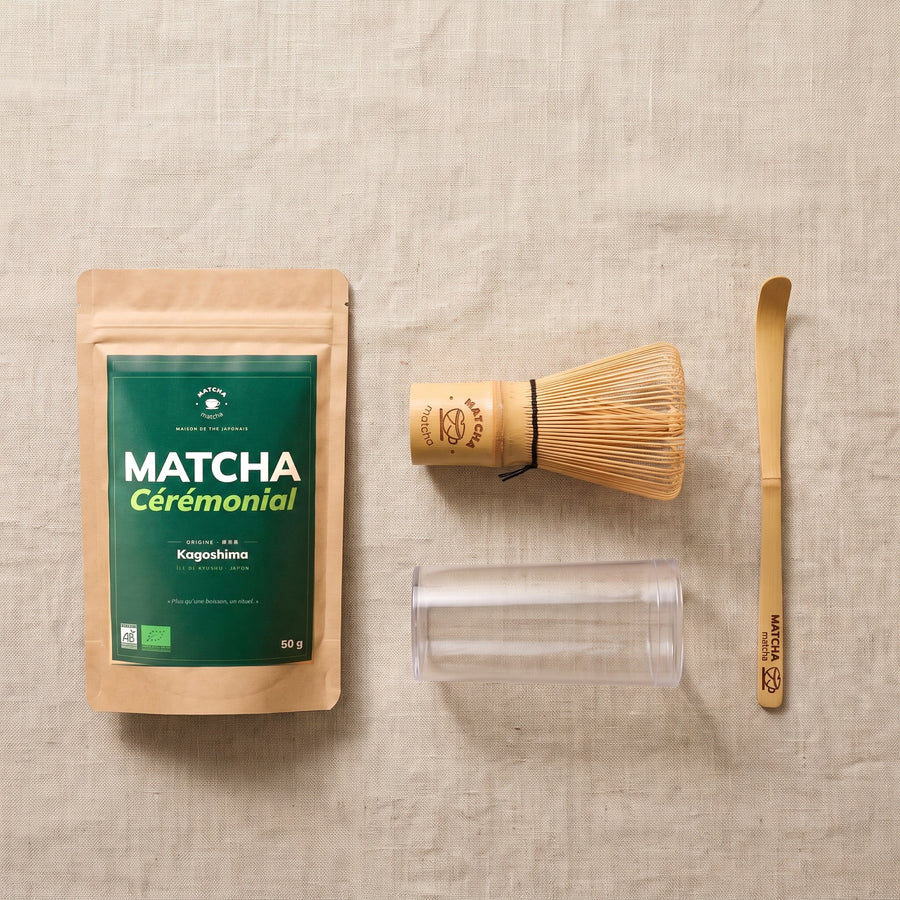 Getting started
Matcha Kit
Everything for your first cup: the matcha, the bamboo matcha whisk (chasen) and the spoon.
44,90 € · 9% cheaper than buying the three separately
Delivered in 3 to 4 days, no customs fees
Professionals
Do you serve matcha?
Serve a smooth matcha that your customers like from the first cup. Organic Ceremonial Matcha in bulk from 1 kg, or under your own brand. Prices and documents are in our trade area, which is open only to cafés, restaurants and retailers.