


Matcha benefits: what the studies say
To date, no health benefit of matcha is recognised in Europe: the EU register has no authorised claim for green tea, its catechins or L-theanine. Researchers study these compounds for possible matcha benefits, with no solid conclusion for a cup. We drink it for its taste, smooth and vegetal.
By the Matcha Matcha team. Updated 8 November 2026, 11 min read.

We went through the official EU register and found 29 health claims about tea, its compounds and caffeine. None is authorised, so a shop has no right to promise them.
What are the claimed benefits of matcha, and what are they worth?
Of 17 common claims, 3 rest on established facts, and none of those 3 describes a health benefit.
What you read most often, checked against the sources, including what we are not allowed to write.
Established
Measured, or stated by a health authority: here, what is in the cup and the precautions.
Studied, no conclusion
Research in humans, often on extracts, with no conclusion that holds for a cup.
Not demonstrated
No trial in humans, or an idea with no scientific definition.
17 of 17 rows shown
| What you read | Level of evidence | What has been studied | For a 1 g cup |
|---|---|---|---|
| "Matcha contains caffeine" | Established | Levels measured in matcha sold in shops [1]. | About 19 to 44 mg for a 1 g cup, roughly double for a 2 g latte. |
| "Tea interferes with iron absorption" | Established | A known effect of tea drunk with a meal [19]. | If you are low in iron, talk to your doctor. In the study cited, waiting one hour after the meal reduced the effect. |
| "Green tea extracts raise questions for the liver" | Established | EFSA, 2018: a rise in liver enzymes from 800 mg of EGCG a day taken as a supplement [9]. | A reference point for supplements. It says nothing about a cup, either way. |
| "Matcha helps you lose weight" | Studied, no conclusion | Cochrane, green tea preparations: a very small loss, of no clinical importance [6]. | Nothing established for a cup. |
| "Matcha is good for your heart" | Studied, no conclusion | Cochrane 2013: none of the 11 trials measured cardiovascular events [13]. | Nothing established for a cup. |
| "Matcha and cancer" | Studied, no conclusion | Cochrane 2020 on green tea: a preventive effect is not proven [7]. | No evidence for a cup. |
| "Matcha improves memory" | Studied, no conclusion | Trial on matcha, 99 older people with self-reported or mild cognitive decline, 2 g a day for 12 months: no significant change on the main outcomes, differences reported on others. Authors linked to a manufacturer [14]. | Not enough to claim it for a 1 g cup. |
| "Matcha helps you sleep better" | Studied, no conclusion | Trial on matcha, 2.7 g a day for 4 weeks: no significant difference in measured sleep time or time to fall asleep, differences reported on other outcomes. Funded by a manufacturer [15]. | Nothing supports it. Caffeine can disturb sleep close to bedtime [8]. |
| "The L-theanine in matcha calms stress" | Studied, no conclusion | Applications reviewed by EFSA [5], 7 entries not authorised in the register [3]. | No conclusion for 1 g of matcha. |
| "Matcha is full of antioxidants" | Studied, no conclusion | Applications reviewed by EFSA [12], not authorised in the register [3]. | It contains catechins. No effect is established at the dose of a cup. |
| "Matcha gives you good skin" | Studied, no conclusion | A 2-year trial on 56 women, polyphenol capsules: no better than placebo [16]. | No evidence for a cup. |
| "Matcha gives gentle energy, with no crash" | Not demonstrated | No trial we read measures this "gentleness". Alertness from caffeine: not authorised in the register [3]. | "Gentle" describes an impression, nothing measured. |
| "Matcha makes your hair grow" | Not demonstrated | A 2007 study on cells and follicles grown in culture [17]. On matcha, no study on hair growth found [18]. | Nothing supports it. Hair loss is something to show a doctor. |
| "Matcha feeds the gut microbiota" | Studied, no conclusion | Mostly animal and laboratory work [18], and one small trial on 33 people [21]. | Nothing established for a cup. |
| "Matcha regulates blood sugar" | Not demonstrated | No authorised claim [3], no randomised trial found on matcha [18]. | Nothing supports it. Diabetes is managed with your doctor. |
| "Matcha boosts immunity" | Not demonstrated | No authorised claim [3], no controlled trial found on matcha [18]. | Nothing established for a cup. |
| "Matcha detoxes the body" | Not demonstrated | The word has no scientific definition [3]. | Nothing to measure, so nothing to demonstrate. |
Skin, hair, gut, heart: what can we really say?
For each of these topics, no study we have read looks at a 1 g cup of matcha.
Matcha and hair
Matcha and the gut
Studied, no conclusion
EFSA has reviewed an application for tea on gut micro-organisms [12], and no claim is authorised on this subject [3]. Of 26 PubMed publications on matcha and the gut, most of those we went through were done in animals or in the laboratory [18]. One small human trial compares the microbiota with that of a placebo group, over two weeks [21]. It does not tell you what a cup does for your health.
Some people report discomfort when they drink tea on an empty stomach: see the possible side effects of matcha.
Matcha and the heart
Studied, no conclusion
The 2013 Cochrane review brings together 11 trials, 7 of them on green tea, with 821 participants in all [13]. They measure cholesterol or blood pressure over short periods, and the authors ask readers to treat the differences with caution.
On matcha, a study in rabbits did not prevent arteriosclerosis caused by their diet [20]. Caffeine can speed up the heart in sensitive people: if this happens to you, talk to your doctor.
Which claims are authorised in Europe?
None for matcha, green tea, its catechins or L-theanine: European Union register checked on 8 November 2026.
In Europe, a shop can in principle only link a food to a health effect if that effect appears on a register kept by the European Commission [2] [3]. Filtered on tea and its compounds, caffeine and matcha, the register gives 29 claims, all "non-authorised". None concerns matcha itself.
The European Food Safety Authority, EFSA, has reviewed applications on green tea catechins and L-theanine: weight, sleep, stress, concentration. None is authorised today [3] [4] [5] [22].
Talking about general beneficial effects also requires an authorised claim alongside it [2]. So on this page, the word "benefits" never describes our matcha: it means what you are looking for, or what you read elsewhere.
29 claims checked, none authorised
Tea, green tea, catechins, EGCG: 15
L-theanine: 7
Caffeine: 7
Every health statement links to a source, and we say when a study is about an extract, animals or green tea in general.
What limits should you know before drinking it?
Two reference points first: caffeine, and iron, as tea can reduce its absorption when drunk with the same meal.
Pregnant or breastfeeding
200 mg of caffeine a day at most according to EFSA, all drinks included [8].
On medication
Green tea and caffeine can interact with some medicines: ask your doctor or pharmacist.
Low in iron
Talk to your doctor, especially if you drink tea with meals [19].
Sensitive to caffeine
At around 100 mg, caffeine can disturb sleep if taken close to bedtime [8].
For a child
Caffeine: ask a doctor first.
This page gives general information. It does not replace the advice of a health professional: if in doubt, talk to your doctor.

So why do people drink it?
Because it tastes good.
A well-made cup of matcha is smooth and slightly vegetal, with a fine foam, and it takes a minute to make. For us, that is enough.
Start with the taste.
No cup can promise you an effect. The taste, though, you can judge straight away.
-
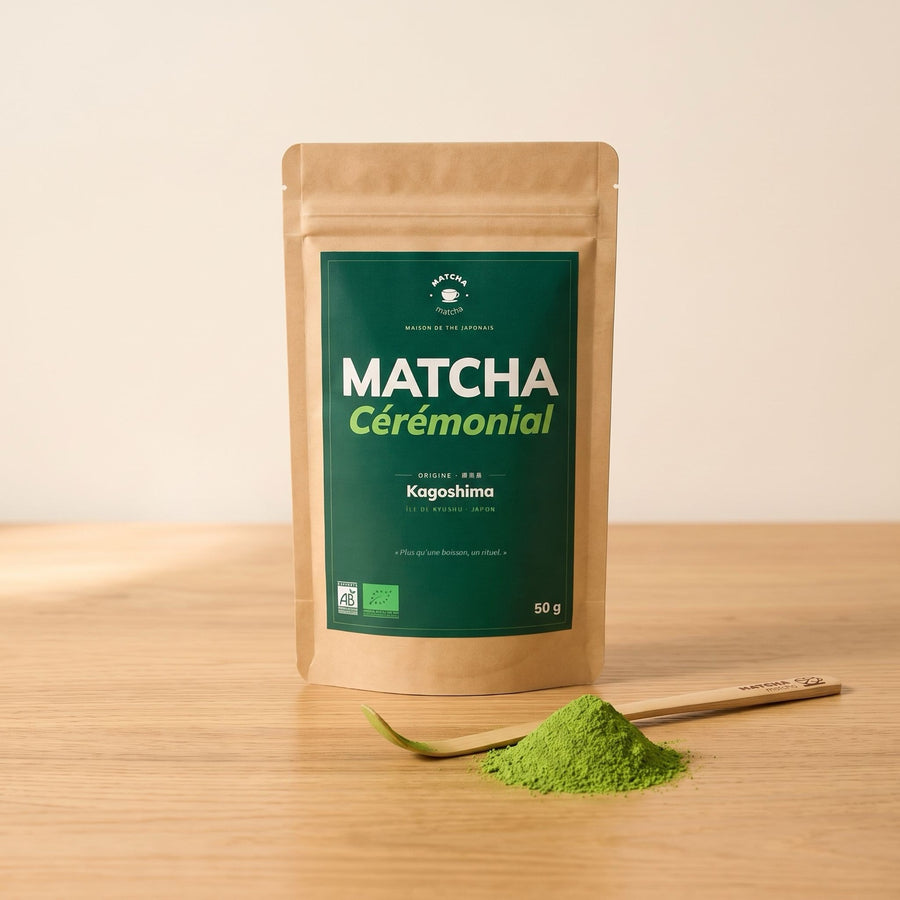 OrganicKagoshima, Japan
Organic Ceremonial Matcha
Smooth from the first sip, even if you don't like green tea.
29,90 € · about €0.60 a cup
What is in a 1 g cup of matcha?
Caffeine, L-theanine and catechins. Only caffeine has a published range, 19 to 44 mg per cup [1]. For the rest, we have no reliable figure.
With brewed green tea, you throw the leaves away. With matcha, you drink them: ground very fine, the leaf stays suspended in the water, which gives it a rounder taste and its texture. That changes what is in the cup. On its own, it says nothing about what the cup does to your body.
Brewed green tea. You only drink the water.
Matcha. You drink the ground leaf.
Nutritional value on the label: 7 kcal per 100 ml, based on 3 g in 200 ml.
Matcha, tea or coffee: caffeine side by side
The caffeine and L-theanine in matcha have their own article. At 1 g, a cup stays below a filter coffee. At 2 g, a latte can come close to one.
Why can't a cup be compared with an extract?
Concentrated extracts provide far more catechins than a drink, and most of the studies and warnings are about them.
Presumed safe
Green tea infusion
Made the traditional way, it is presumed safe by EFSA [9]. The leaves stay in the filter.
No conclusion
Matcha, a leaf powder
Do not combine matcha with a green tea supplement, and ask your doctor if you already take one.
What do studies on green tea and matcha say?
Almost all of them look at green tea in general or at extracts, and very few at matcha itself.
A 2021 review on matcha concludes that randomised trials are still needed [1]. Since then, a few small trials have come out, often linked to a manufacturer. Tap a step to see what it allows you to say.
Cells in the laboratory
Can tell you A possible mechanism, in a culture dish.
Cannot tell you What happens once the cup is drunk and digested.
Animals
Can tell you What a substance does in mice, rats or rabbits.
Cannot tell you What holds for a person, at a different dose.
Observing tea drinkers
Can tell you A link between tea and what is observed over several years.
Cannot tell you That tea is the cause: these drinkers also differ in how they live.
Placebo-controlled trial
Can tell you The difference between a group taking the product and a placebo group.
Cannot tell you What holds beyond the dose, the duration and the number of participants. Check who pays for it.
Review of trials
Can tell you What several trials say together, and how solid the whole is.
Cannot tell you More than those trials are worth. On green tea, they are often dosed preparations.
Your cup, 1 g
Can tell you One gram of ground leaf, in water.
Cannot tell you None of the above applies to it directly. Trials use 1.5 to 4 g a day. At 1 g, we found none.
When you look at a study, three questions are enough: on what, with what, at what dose? Yours is one gram.
What is matcha tea credited with, and why?
Mostly what green tea is credited with, only stronger, because you drink the whole leaf.
This shortcut forgets the dose, and that an extract, an infusion and a powder are three different products.
In Japan, matcha has been part of life for monks and the tea ceremony for centuries. That tells you about its place in the culture, and nothing about its effects.
Two things people say
"The greener it is, the better it is for your health."
False
A bright green shows shading and freshness: a guide to taste, not to health.
"It's natural, so it can't do any harm."
False
It contains caffeine, and the EFSA reference values apply to it too [8].
And the latte? Same reservations, twice the caffeine. For the rest, how to make a matcha latte is a question of taste.
Frequently asked questions
Is matcha good for you?
No health claim is authorised for it in Europe to date, and research on its compounds reaches no conclusion for a cup. People drink it first of all for its taste.
Does matcha help you lose weight?
Nothing allows us to say so. In the Cochrane review of green tea preparations, the weight loss measured is very small and of no clinical importance.
Does matcha contain antioxidants?
It contains catechins, which are tea polyphenols, but no effect is established at the dose of a cup and no claim is authorised in Europe.
Can you drink matcha in the morning?
Yes, like a tea or a coffee: its caffeine is more of a problem close to bedtime.
What are the contraindications of matcha tea?
If you are pregnant, breastfeeding, on medication or low in iron, or for a child, ask your doctor first. The details are in the possible side effects of matcha.
Sources
Documents consulted on 8 November 2026. Some EFSA opinions are cited from their title and the EU register.
See all 22 sources
- Kochman J. et al., review on matcha, Molecules, 2021 (cites Koláčková et al., 2020, for caffeine). pmc.ncbi.nlm.nih.gov
- Regulation (EC) No 1924/2006, consolidated version. eur-lex.europa.eu
- European Commission, EU register of nutrition and health claims, consulted on 08/11/2026. ec.europa.eu
- EFSA, scientific opinion on health claims related to Camellia sinensis and catechins, EFSA Journal 2011;9(4):2055. efsa.europa.eu
- EFSA, scientific opinion on health claims related to L-theanine, EFSA Journal 2011;9(6):2238. efsa.europa.eu
- Jurgens T. et al., green tea and weight, Cochrane, 2012, CD008650. cochrane.org
- Filippini T. et al., green tea and cancer, Cochrane, 2020, CD005004. cochrane.org
- EFSA, scientific opinion on the safety of caffeine, 2015;13(5):4102, and its Caffeine page. efsa.europa.eu
- EFSA, scientific opinion on the safety of green tea catechins, 2018;16(4):5239. pmc.ncbi.nlm.nih.gov
- Regulation (EU) 2022/2340. eur-lex.europa.eu
- Anses, the French food safety agency, opinion 2011-SA-0130, 7 August 2012. anses.fr
- EFSA, scientific opinion on tea, including green tea catechins: DNA and lipids, gut micro-organisms, blood pressure, cholesterol, EFSA Journal 2010;8(2):1463. efsa.europa.eu
- Hartley L. et al., green and black tea for the primary prevention of cardiovascular disease, Cochrane, 2013, CD009934. cochrane.org
- Uchida K. et al., 12-month randomised trial, PLoS One, 2024. Conflicts of interest declared with a tea manufacturer. pubmed.ncbi.nlm.nih.gov
- Baba Y. et al., randomised trial on sleep, Nutrients, 2024. Funded by a tea manufacturer. pubmed.ncbi.nlm.nih.gov
- Janjua R. et al., two-year randomised trial, Dermatologic Surgery, 2009. pubmed.ncbi.nlm.nih.gov
- Kwon O. S. et al., in vitro study on EGCG, Phytomedicine, 2007. pubmed.ncbi.nlm.nih.gov
- PubMed, searches of 08/11/2026: matcha with hair or alopecia (3 results), skin (4), gut or microbiota (26), immunity and blood sugar (no randomised trial). pubmed.ncbi.nlm.nih.gov
- Ahmad Fuzi S. et al., American Journal of Clinical Nutrition, 2017. pubmed.ncbi.nlm.nih.gov
- Hunjadi M. et al., study in rabbits on matcha powder and arteriosclerosis, Molecular Nutrition & Food Research, 2021. pubmed.ncbi.nlm.nih.gov
- Morishima T. et al., double-blind randomised trial on the microbiota, 33 people, Journal of Clinical Biochemistry and Nutrition, 2023. pubmed.ncbi.nlm.nih.gov
- EFSA, scientific opinion on green tea catechins and body weight, EFSA Journal 2010;8(10):1791. efsa.europa.eu
If you would like to taste it
-
OrganicKagoshima, Japan
Organic Ceremonial Matcha
Smooth from the first sip, even if you don't like green tea.
29,90 € · about €0.60 a cup
-
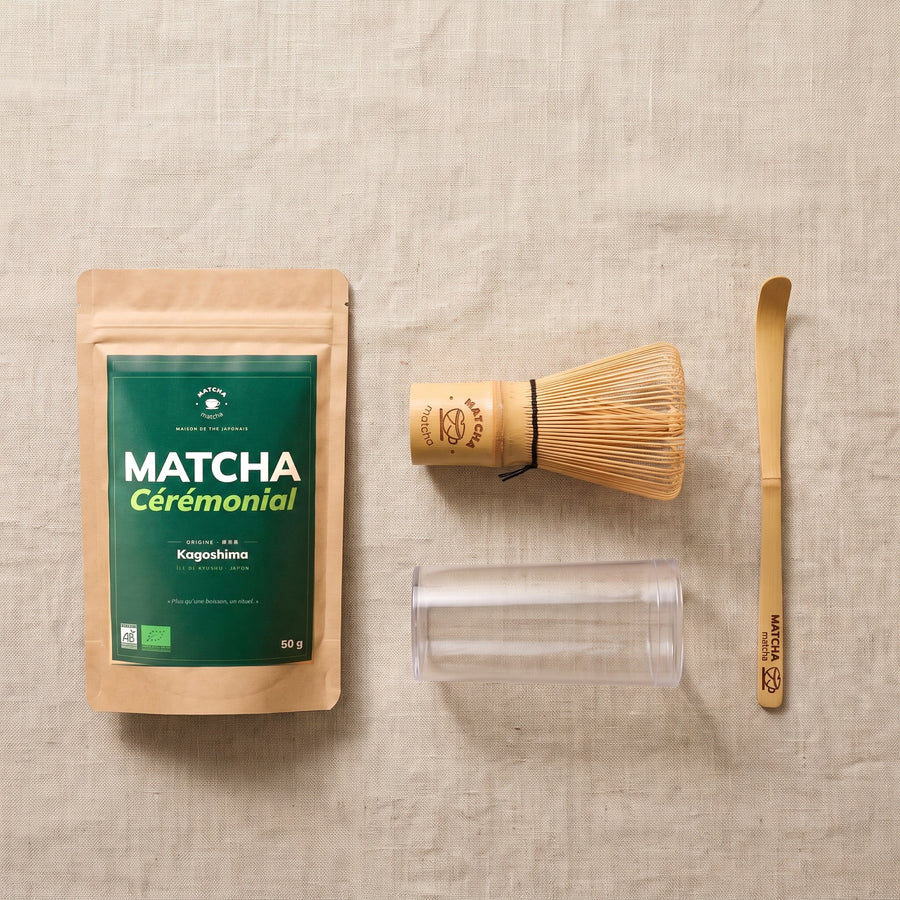 Getting started
Matcha Kit
Everything for your first cup: the matcha, the bamboo matcha whisk (chasen) and the spoon.
44,90 € · 9% cheaper than buying the three separately


Professionals
Do you serve matcha?
Serve a smooth matcha that your customers like from the first cup. Organic Ceremonial Matcha in bulk from 1 kg, or under your own brand. Prices and documents are in our trade area, which is open only to cafés, restaurants and retailers.