Where does matcha come from? Japan's matcha regions and Kagoshima
Japanese matcha comes mainly from five regions: Kagoshima, Kyoto, Nishio (Aichi), Shizuoka and Yame (Fukuoka). None is better on principle. Kagoshima produces the most tencha, the leaf matcha is made from, and Kyoto carries its history. Ours comes from Kagoshima, and only from there.
By the Matcha Matcha team
Contents 8 portions
- Where does matcha grow in Japan?
- Kagoshima matcha: what the south of Japan changes
- Kyoto, Nishio, Shizuoka, Yame: the character of each region
- Kyoto or Kagoshima matcha: which should you choose?
- Is the region enough to judge a matcha?
- Which region for which use?
- Our matcha: Kagoshima and nowhere else
- Sources
Where does matcha grow in Japan?
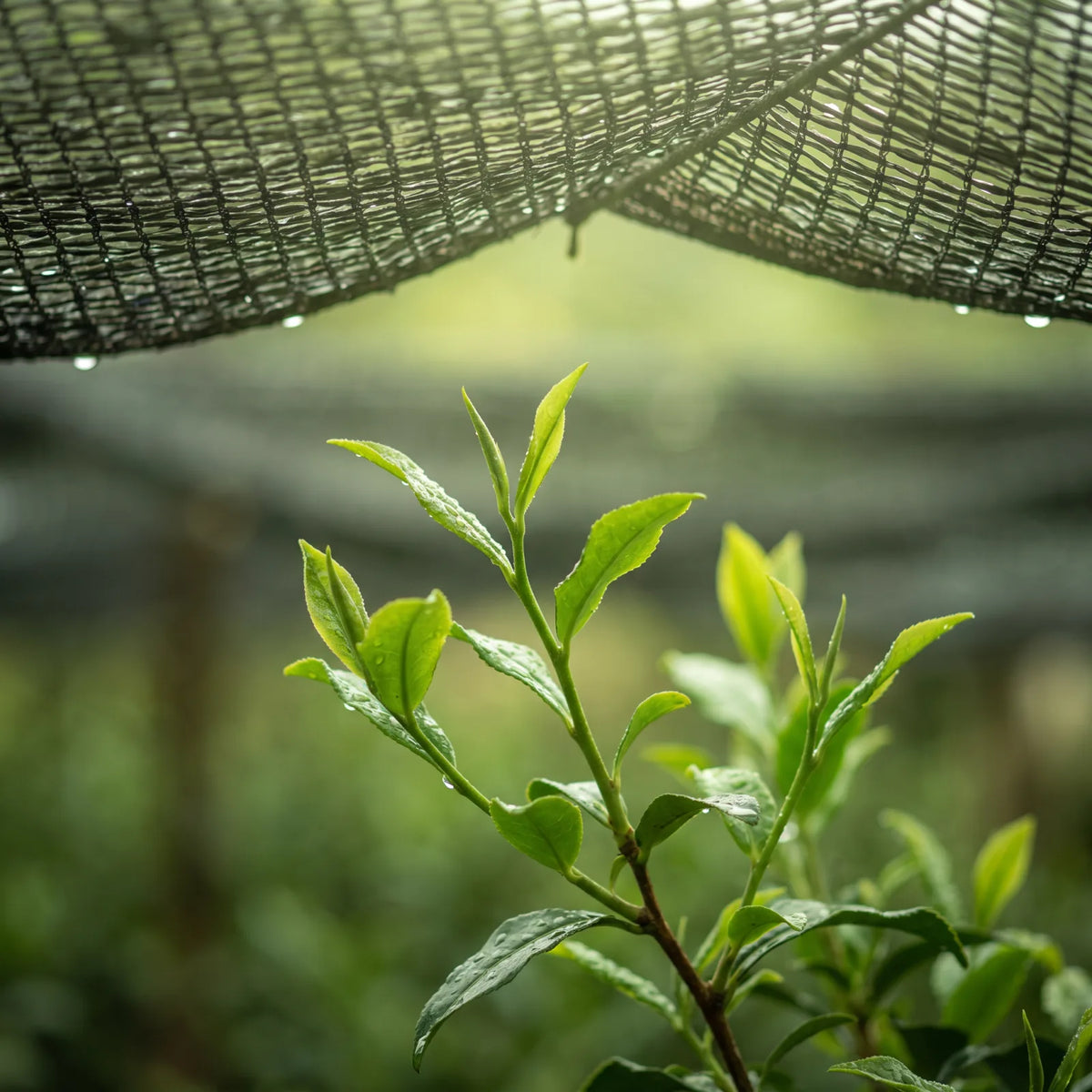
Where does matcha come from? From the places that grow tencha: a tea leaf that is shaded before harvest, dried without being rolled, then ground into powder. So a big tea region is not always a big matcha region. Tencha makes up 26% of the tea produced in Kyoto prefecture, 8% in Kagoshima and 2% in Shizuoka, which was for a long time the country's largest tea producer.
For its history and how it is made, read what is matcha.
| Prefecture | Tencha produced in 2024 | Share of Japan |
|---|---|---|
| Kagoshima | 2,150 t | 40% |
| Kyoto | 1,068 t | 20% |
| Shizuoka | 611 t | 11% |
| Others, including Aichi (Nishio) | 1,507 t | 28% |
| Japan | 5,336 t | 100% |
Source: Kagoshima prefecture, June 2026, based on figures from the Japan Tea Central Association. "Others" is calculated by subtraction.
The next table gives general tendencies. One tea garden can produce very different matchas depending on the cultivar and the season.
| Region | Prefecture | Climate and land | In the cup |
|---|---|---|---|
| Kagoshima | Kagoshima, southern Kyushu | Mild, humid, volcanic soils; one of the earliest springs in the country | Smooth, round, vegetal |
| Yame | Fukuoka, northern Kyushu | Hills and morning fog | Rich, strong umami |
| Kyoto | Kyoto | Cool valleys, river fog | Delicate, umami |
| Nishio | Aichi | Fertile plain of the Yahagi river | Balanced |
| Shizuoka | Shizuoka, at the foot of Mount Fuji | Temperate, sunny | Vegetal, fresh |
Kagoshima matcha: what the south of Japan changes
You recognise a Kagoshima matcha first by how smooth it is, and the calendar has a lot to do with that.
Tender leaves, among the first of the year
Kagoshima is the southernmost prefecture on the island of Kyushu. With its mild climate and early spring, the season starts very early: the Japanese Ministry of Agriculture places the very first new teas at the end of March, and the prefecture starts its spring harvest in April.
Steady growth
On these volcanic soils and in this mild climate, the young leaves grow fast and evenly.
One of Japan's two big tea regions
Kagoshima is one of the two largest tea-producing regions in Japan. It is still second by area, with 8,040 hectares in 2025 against 11,600 in Shizuoka. In 2024 it came first by volume for the first time, with 26,980 tonnes of crude tea against 25,800. Shizuoka took back the lead for the spring harvest in 2026, according to the daily newspaper Yomiuri.
These rankings cover all tea, sencha included. For matcha, the figure that counts is tencha, and there Kagoshima comes first, with 40% of national production. It more than doubled its tencha in three years, from 1,007 tonnes in 2021 to 2,150 in 2024.
More taste profiles
Tea gardens in Kagoshima grow a wider mix of cultivars, so their aromas and harvest dates vary more. Yabukita dominates Japanese tea gardens by a wide margin. In Kagoshima it shares the land with other cultivars such as Yutakamidori and Saemidori. Saemidori is valued for tencha because it copes well with shading.
The widest choice of organic tea
If you are looking for an organic matcha from Japan, Kagoshima is where you are most likely to find it. The prefecture had 926 of Japan's 1,805 hectares of certified organic tea plants in 2024, or 51%, against 17% in Shizuoka.
What this means in the cup
Matcha in general tastes smooth and vegetal, and there is sometimes a slight bitterness. Matcha from Kagoshima leans towards smooth and round, as long as it has been well shaded: the prefecture's tea producers' association points out that the strong southern sun raises the astringent compounds in the leaf, while the cover laid before harvest favours the amino acids, which give it a sweet taste. We say more about this in what does matcha taste like.
Kyoto, Nishio, Shizuoka, Yame: the character of each region
Kyoto: the history of Japanese matcha
Kyoto prefecture is the historic birthplace of Japanese matcha. The Ministry of Agriculture places the development of tea shading within this tradition, in the 16th century. People associate Kyoto with a delicate matcha, rich in umami.
Kyoto's regional tea name has a precise definition: the tea is processed in Kyoto prefecture, using the method born there, from leaves grown in Kyoto, Nara, Shiga or Mie. So it names a skill as much as a place.
Nishio, in Aichi: the tencha specialist
On the plain of the Yahagi river, Nishio has specialised in tencha. Its name is protected: "Nishio no Matcha" is a Japanese geographical indication. The region also supplies a lot of matcha for cooking and drinks.
Shizuoka: the big sencha region
At the foot of Mount Fuji, Shizuoka was the largest tea-producing prefecture until 2023, mainly because of its sencha. It is now turning to tencha: 71.1 hectares were converted there in 2025, according to the Yomiuri. Its matchas often have a fresh, vegetal profile.
Yame, in Fukuoka: fog and umami
In northern Kyushu, the mountains create a big difference in temperature between morning and evening. This brings morning fog that helps the leaf keep its umami. Yame owes its reputation to its gyokuro, a shaded tea that is also protected by a geographical indication. Its matchas are rich and strong.
Mie, Miyazaki, Saitama and Nara
Mie and Miyazaki are among the big tea prefectures, and Saitama has its Sayama tea. Nara is one of the prefectures whose leaves can go into Kyoto's regional tea.
Kyoto or Kagoshima matcha: which should you choose?
Choose Kyoto for its history and its delicate umami, Kagoshima for the smoothness of an early harvest and a wider organic choice. They are two profiles, and neither one beats the other outright.
| Kyoto prefecture | Kagoshima | |
|---|---|---|
| What people come for | History, tradition | Smoothness, organic tea |
| Tencha, share of Japan in 2024 | 20% | 40% |
| Spring | Later | Among the earliest |
| In the cup | Delicate, umami | Smooth, round, vegetal |
If you like a very strong umami taste and the history of the place matters to you, Kyoto has plenty to offer. If you are new to matcha, if you drink it with water or if organic comes first, Kagoshima will be easier to like.
We sell matcha from Kagoshima, so take our opinion with a pinch of salt. We chose it for a simple reason: it is the smoothest matcha we have tasted, with water and in a latte. To get to know us, read our story.
Is the region enough to judge a matcha?
No. It gives a tendency, and four other things weigh at least as much in your cup:
- The harvest decides how smooth it is: spring leaves are the most tender.
- Shading brings umami and limits the bitterness of the leaf.
- The cultivar steers the aromas.
- The grinding decides how fine the foam is.
We go through these criteria in matcha grades.
The name of a region does not tell you which harvest it is either. Kagoshima's climate allows up to four harvests a year in some areas. So "Kagoshima" on a pouch is not enough: ask whether it is a first harvest too.
On a pouch, look for the country and the region where the leaves were grown. "Processed in Japan" says nothing about where the tea was grown. Geographical indications do exist in Japan, and Nishio has one, but a pouch without one is no worse for that. To choose a seller, read where to buy the best matcha powder and how to choose it.
Which region for which use?
Start from what you are making. The region comes second.
- With water, nothing hides the taste of the matcha: a smooth profile, like Kagoshima's, or a delicate one, like Kyoto's, suits it well. Use 1 g for 70 to 100 ml of water at 70-75 °C, and follow our guide on how to make matcha.
- In a latte, the milk rounds everything off: look for a matcha strong enough to keep its taste, and use 2 g. The quantities and the method are in how to make a matcha latte.
- In cooking, the heat and the sugar take over. Matchas from Nishio are used a lot here.
Our matcha: Kagoshima and nowhere else
Our Organic Ceremonial Matcha comes from Kagoshima, and from no other region.
- A smooth and vegetal taste from the first cup, because we take the first harvest of the year.
- A rounder flavour, from about 21 days of shading before harvest, on tea plants of the Yabukita variety.
- A fine foam, because the leaf is stone-ground.
- A matcha you can check: it is certified organic and tested by an accredited laboratory, as our Transparency page explains.
Sources
- Kagoshima prefecture, Current state and challenges of the Kagoshima tea sector, meeting of 3 June 2026: crude tea, areas, tencha by prefecture (based on the Japan Tea Central Association), cultivars, organic areas (based on the Ministry of Agriculture). https://www.pref.kagoshima.jp/ag06/chagyoshinkou/documents/128656_20260611190751-1.pdf
- Kagoshima prefecture, Plan for Kagoshima tea, March 2019: start of the spring harvest, variety of cultivars. https://www.pref.kagoshima.jp/ag06/documents/71400_20190325223604-1.pdf
- Kagoshima tea producers' association, About Kagoshima tea: sunshine, cover before harvest. https://kagoshima-cha.or.jp/knowledge/kagoshimacha/
- Japanese Ministry of Agriculture (MAFF), Kagoshima Tea: climate, first new teas from the end of March. https://www.maff.go.jp/e/policies/market/dento_syoku/menu/kagoshima_tea.html
- MAFF, page on Kyoto prefecture tea: definition of the regional tea name, shading in the 16th century. https://www.maff.go.jp/e/policies/market/dento_syoku/menu/uzi_tea.html
- MAFF, Beverages: tea prefectures and regional tea names. https://www.maff.go.jp/e/policies/market/dento_syoku/bunrui/inryou.html
- MAFF, register of geographical indications, no. 5 Yame Dento Hon Gyokuro. https://www.maff.go.jp/e/policies/intel/gi_act/register/s5.html
- MAFF, register of geographical indications, no. 27 Nishio no Matcha. https://gi-act.maff.go.jp/en/register/entry/27.html
- The Yomiuri Shimbun, republished by Asia News Network, 12 October 2026: Shizuoka and Kagoshima at the spring harvest, areas converted to tencha. https://asianews.network/?p=307195
Frequently asked questions
Where is matcha grown?
In Japan, it is mostly grown in the prefectures of Kagoshima, Kyoto, Aichi, Shizuoka and Fukuoka. Kagoshima produced 40% of Japanese tencha in 2024, ahead of Kyoto (20%) and Shizuoka (11%).
Which city is the home of matcha?
No single city sums it up. Kyoto is named most often for its history, and Nishio for its specialisation in tencha. By volume of tencha, Kagoshima prefecture comes first.
Is Kagoshima the largest tea-producing region in Japan?
It is one of the two largest, with Shizuoka. Kagoshima took the lead for crude tea in 2024, for the first time, and Shizuoka still has the largest area. The ranking can change from one year and one harvest to the next.
Does organic matcha come mostly from Kyoto?
No, not according to the certified areas. In 2024, Kagoshima had 51% of Japan's certified organic tea plants, far ahead of Shizuoka (17%). Kyoto is known for other things: its history and its delicate matchas.
Does a matcha sold under the name of a region always come from that region?
Not always. Kyoto's regional tea, for example, can be made from leaves grown in four prefectures, and the place of grinding can differ from the place of growing. Look for the region where the leaves were grown.
Are you a professional? We are a matcha supplier for professionals.