How to store matcha
Keep matcha in its pouch, tightly closed, away from light, heat and moisture. Unopened, it usually keeps for 24 months, until the best-before date on the back of the pouch. Once opened, we recommend finishing it within 30 to 45 days. After that, it starts to lose its colour, its scent and its smoothness.
By the Matcha Matcha team
Contents 11 portions
- How long does matcha keep?
- Why 30 to 45 days, when you often read 2 to 3 months?
- What damages matcha?
- How to store matcha once opened
- Should you keep matcha in the fridge?
- In summer, at the office, when travelling: where should the pouch go?
- How long does a 50 g pouch last?
- Expired matcha: how can you tell if it is still good?
- What to do with matcha that has lost its freshness?
- 8 mistakes that age a pouch
- Sources
You opened a pouch a few weeks ago, or you have just found one at the back of the cupboard, and you wonder if it is still good for a cup. Here is how to store matcha, what the fridge is good for, how long it lasts and how to check in ten seconds that it is still good.
How long does matcha keep?
The answer changes on the day you open the pouch. While it is sealed, no air gets in. After the first cup, a little air gets in every time.
| Situation | How long | What to do |
|---|---|---|
| Unopened pouch, somewhere cool and dark | Usually 24 months, until the best-before date on the back of the pouch | Only open it once the previous one is finished |
| Opened pouch, tightly closed | We recommend 30 to 45 days | Write the opening date on the pouch |
| Prepared matcha, with water or milk | Drink it straight away | A whisked concentrate keeps in the fridge, covered, until the next day: that is a rule of thumb from experience |
Why 30 to 45 days, when you often read 2 to 3 months?
Depending on the seller, you will find anything from four weeks to six months after opening, and most often two to three months. As far as we know, there is no official figure: everyone gives their own. Ours is shorter because we count the time during which the powder keeps the taste you bought it for. It stays drinkable for longer, but that is not the period we care about.
First, a pouch gets opened often: at one cup a day, that is around thirty rounds of fresh air in a month. Second, matcha is a leaf ground very finely. A whole leaf still protects its centre, but here every grain is in contact with the air that gets in. And we think of the cup made with water, the one that shows everything: with no milk or sugar, a slightly tired powder comes through from the first sip. In a latte, it takes you longer to notice.
Research points the same way, without setting a time limit. A study published in Food Science and Biotechnology followed matcha for two months at several temperatures: its colour lost its brightness, and its catechin and caffeine levels fell, more so as the temperature rose and time passed. Another, published in Food Chemistry, measured the effect of moisture and light. The damper and more brightly lit the powder, the more these compounds declined. Under continuous light, some catechins lost half their content in roughly 30 to 40 days.
Be careful with what these figures say. Lab conditions are harsher than a pouch kept in a cupboard, and neither study gives a use-by date. We take one thing from them: here, time is counted in weeks.
Past 45 days, there is no need to worry. A well-kept powder fades slowly; it does not go bad overnight. We chose the period that gives you the best chance of a smooth, vegetal matcha in your cup, even if it makes us look a little strict.
What damages matcha?
This fragility comes from the way it is made, which we explain in our guide to matcha tea. Day to day, here is what wears it down and what to do about it.
| What damages it | What you lose | What to do |
|---|---|---|
| Air | The green colour and the scent: this is oxidation | Press the air out and close it tightly |
| Light | The brightness of the colour | In a cupboard, or in an opaque tin |
| Heat | The colour and the scent, faster the warmer it is | Away from the oven and the kettle |
| Moisture | The fineness of the powder, which forms lumps | A completely dry spoon |
| Odours | The clean taste: tea picks up the smells around it | Away from coffee, spices and onions |
How to store matcha once opened
1. Leave it in its pouch
The simplest way is to leave it in its pouch, tightly closed, and keep the pouch in a cupboard. If you prefer a tin, choose a small, opaque, airtight one, in metal or ceramic. Avoid a clear glass jar, however nice it looks on a shelf.
2. Press the air out every time
The less air left in the pouch, the longer the green lasts. Flatten it gently before you close it.
3. Use a dry spoon
A single drop is enough to form lumps. Measure out your matcha before you take out the whisk or the kettle, and never whisk over the pouch.
4. Choose a cool cupboard
Around 15 to 20 °C is ideal. Avoid the cupboard above the oven, the worktop next to the kettle and the sunny shelf.
5. Write down the opening date
One line of marker pen on the pouch. A few weeks from now, you won't remember.
The rest happens when you make your cup: here is how to prepare matcha.
Should you keep matcha in the fridge?
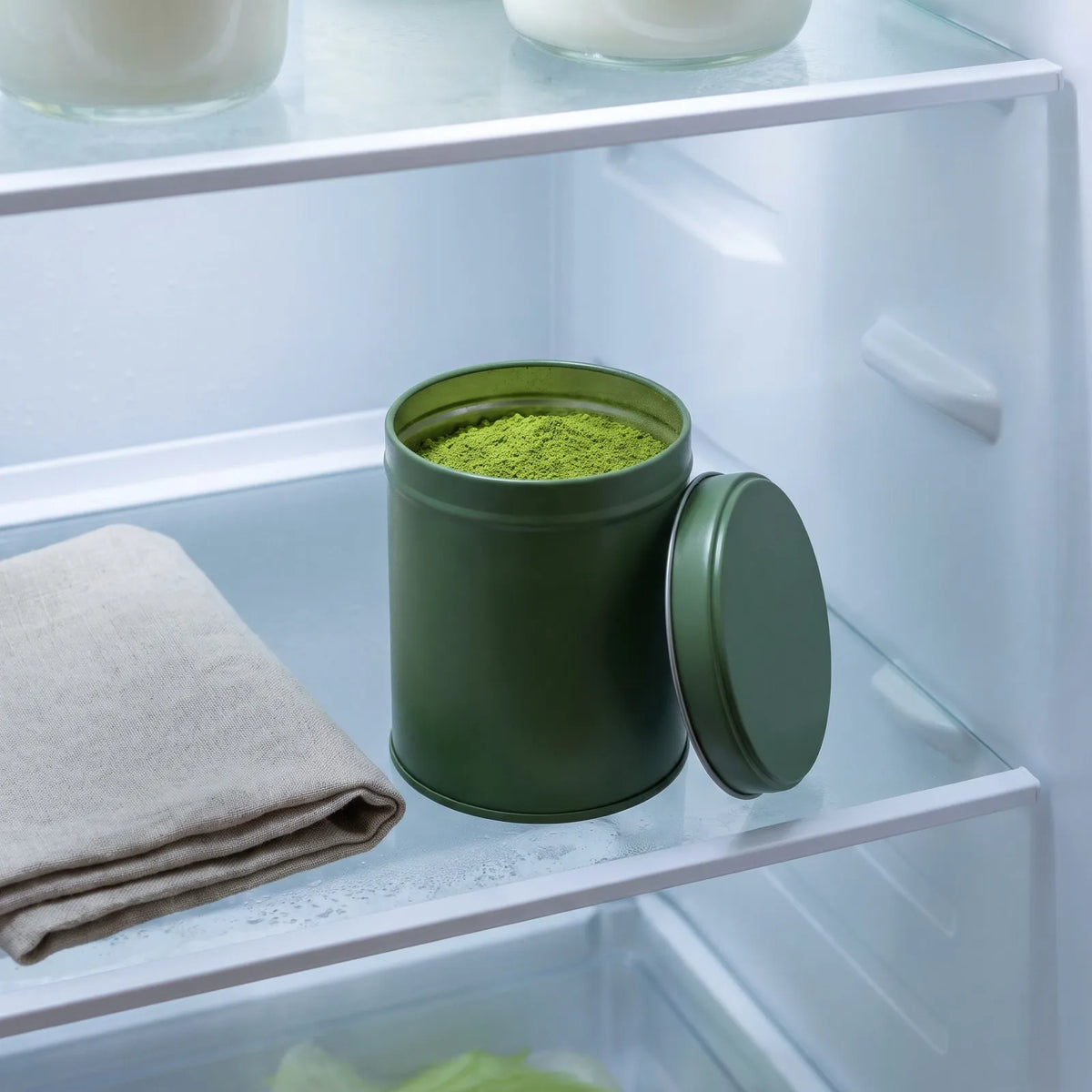
Not necessarily. In a cool kitchen, a cupboard is enough. The fridge becomes useful when the room is often above 25 °C, in summer or near the hob, because heat wears the powder down faster.
Its drawback is condensation: a cold pouch opened in a warm room gets covered in a thin film of moisture, and the powder soaks it up. A few precautions solve the problem.
- Keep the pouch tightly closed, away from cheese, onions and leftovers.
- Take it out 10 to 15 minutes before opening it, so it can come back to room temperature.
- Put it back in the fridge as soon as you have measured out your cup.
What about the freezer?
For an opened pouch, we don't recommend it: each time you take it out, more condensation forms and the powder picks up moisture. For an unopened pouch, it adds nothing, since it already keeps for 24 months in a cupboard as a rule.
In summer, at the office, when travelling: where should the pouch go?
Your parcel arrives during a heatwave? Put the pouch somewhere cool as soon as you have collected it.
At the office, choose a drawer over a windowsill. The shared fridge is a bad idea: everyone opens it, and your pouch spends its days next to your colleagues' lunches.
When travelling, take only the amount you need for the next few days in a small opaque tin, and leave the pouch at home. Avoid the glove box, which heats up very quickly as soon as the car is parked.
Going away for several weeks with an opened pouch? Put it in the fridge, tightly closed, and remember that the count goes on while you are away. When you come back, smell it before you prepare it, and if it has passed 45 days, trust your nose rather than the calendar.
How long does a 50 g pouch last?
At 1 g per cup, a pouch gives you 50 cups. A latte needs 2 g. To finish it within 30 to 45 days, count on about 1.1 to 1.7 g a day.
| Your routine | Powder per day | Pouch finished in | Within 30 to 45 days? |
|---|---|---|---|
| 1 cup a day | 1 g | 50 days | Almost |
| 1 cup a day and 1 latte a week | about 1.3 g | about 39 days | Yes |
| 2 cups a day | 2 g | 25 days | Easily |
| 1 latte a day | 2 g | 25 days | Easily |
| 1 cup and 1 latte a day | 3 g | about 17 days | Easily |
| 3 cups a week | about 0.4 g | nearly 4 months | No: finish it in your baking |
One cup a day takes you to 50 days, just past our window: an occasional latte is enough to catch up. If you drink less, share the pouch or keep the end for a cake.
When you buy two, only open one: the second stays sealed and keeps its date. On the other hand, a large amount opened to last six months wears out long before it is finished. The no-commitment subscription, 10% cheaper, follows the same logic: a fresh pouch every month, or every two months if you drink less. And if you are wondering how much to drink, read drinking matcha every day.
Expired matcha: how can you tell if it is still good?
The printed date
The date on the back of the pouch is a date of minimum durability, the familiar "best before". EU law defines it as the date until which a food keeps its properties, if it is stored properly. The use-by date, the one that signals a risk, is kept for highly perishable foods.
Once that date has passed, it is mainly the green colour and the scent that fade. As far as we know, no study has looked at very old matcha, so we cannot promise you it is fine to drink in every case. If in doubt, and especially if the powder has taken on moisture, don't use it.
The ten-second test
Open the pouch, look, smell. Then, if everything seems normal, make a small cup: 1 g for 70 to 100 ml of water at 70-75 °C.
| What you notice | What it means | What to do |
|---|---|---|
| Bright green, fresh grassy smell | All is well | Carry on |
| Smooth and vegetal taste, sometimes a slight bitterness | That is matcha | Carry on |
| Dull powder, less green | It is starting to lose its freshness | Finish it soon, ideally in a latte |
| Powder turning yellow, khaki or brown | It has oxidised | Keep it for baking |
| Smell of hay, dust or old cardboard | It has lost its freshness | Keep it for baking |
| Small lumps that crush under your finger | Fine powder settles. This is normal | Pass it through a small sieve |
| Hard, sticky lumps | It has taken on moisture | Don't drink it |
| Spots, fuzz, mouldy smell | Mould | Throw the pouch away |
Your cup tastes bitter or flat even though the powder looks fresh? The water or the dose is often the cause: our page on the taste of matcha helps you tell the difference.
What to do with matcha that has lost its freshness?
If that is its only fault, don't throw it away. Baking forgives what a cup made with water reveals: a cake, cookies, a cream, with butter, sugar or white chocolate around it. Pick from our matcha recipes, or see how to make a matcha latte for a powder that is only a little tired.
Resist the urge to add more to make up for it. The scent does not come back, and too much powder feels rough in the mouth. For a cup made with water, start again with a fresh pouch.
8 mistakes that age a pouch
- Leaving it on the worktop, next to the kettle.
- Pouring it into a clear jar.
- Dipping a damp spoon into it.
- Leaving it open while the water heats up.
- Only half closing it.
- Opening it straight out of the fridge, while it is still cold.
- Keeping it near the coffee or the spices.
- Opening two pouches at the same time.
Sources
- "Effect of storage temperature on the antioxidant activity and catechins stability of Matcha (Camellia sinensis)", Food Science and Biotechnology, 2020: https://doi.org/10.1007/s10068-020-00772-0
- "Effect of water activity and light exposure on the stability of bioactive compounds in matcha (Camellia sinensis) powder during storage periods", Food Chemistry, 2026: https://doi.org/10.1016/j.foodchem.2026.148655
- Regulation (EU) No 1169/2011, Articles 2 and 24, date of minimum durability: https://eur-lex.europa.eu/legal-content/FR/TXT/HTML/?uri=CELEX:32011R1169
Frequently asked questions
How should you store matcha once opened?
In its pouch, tightly closed, in a cool, dry cupboard. We recommend finishing it within 30 to 45 days of opening.
Does matcha tea go off?
Its date is a quality date: over time, it turns dull and loses its scent. If it has taken on moisture or shows any sign of mould, don't consume it.
Why keep matcha in the fridge?
To protect it from heat when the room is often above 25 °C. Wait 10 to 15 minutes before opening the pouch, to avoid condensation.
My matcha has turned yellow. Can I drink it?
Powder that turns yellow has oxidised. It will be disappointing in a cup made with water: keep it for baking, as long as it still smells of tea and has no hard lumps or mould.
How long does a matcha latte keep?
Drink it straight away: the colour and the foam don't last. A whisked matcha concentrate keeps in the fridge, covered, until the next day: that is a rule of thumb from experience.
Is an unopened pouch at risk from anything?
Heat and light, mainly. Kept somewhere cool and dry, it usually keeps for 24 months, until the best-before date printed on the pouch.